


Cotton
What is cotton?
Cotton is a plant fiber.
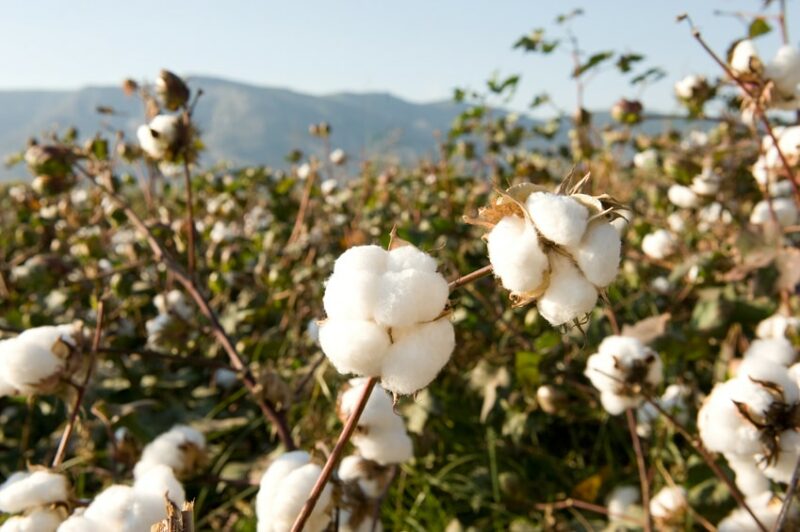
It neither comes from a tree nor has anything to do with wool (from sheep, keratin fiber). Cotton is a plant fiber, meaning it is of plant origin. When the buds (bolls) open, the cotton seed fibers appear. These are the seed hairs of the cotton plant (Gossypium), which belongs to the mallow family. It can be picked by hand, as was customary in the past, or harvested industrially and processed further by machine. Take a look at our cotton blankets.
Worth Knowing
Colors
white, white-brown and also green
The main producing countries in order of importance:
China
India
United States (especially the Southern states - California, Texas, Mississippi)
Pakistan
With a current global production of approx. 26 million tons/year, approx. 47% of all
textile products are manufactured. Another approx. 47% are made from synthetic materials.
Organic Cotton
There is also organic cotton (currently about 1%), such as Organic Cotton or kbA (controlled organic cultivation) cotton, which has a better ecological balance and lower pollutant levels for humans and the environment. Here you can find our summer duvet in kbA cotton
The global share of organic quality is only about 1%. For the Ritter-Decken summer cotton duvet, we use cotton from kbA (controlled organic cultivation). Additionally, it has been tested for harmful substances by the Bremen Environmental Institute.
Fineness: approx. 3-5 microns
Length: 2.5-4 cm
Price: approx. 1.80 Euro/kg (standard quality)
History
Cotton was processed into textiles in India as early as 3000 BC. Before 2000 BC, cotton reached Mesopotamia, Egypt, and later Europe. In Africa, it was found in forests and grass savannas. In South America, cotton textiles dating back to 3000 BC can also be found in the Andes. At that time, cotton was a luxury good that was traded expensively.
Qualitatively, cotton is primarily judged by its staple length. Further criteria include smell, color, provenance and purity, and how it is harvested and cultivated today.
Originally valued as a luxury fiber, it is now available relatively inexpensively in sufficient quantities due to mechanical harvesting and processing.
Applications: shirts, towels, tablecloths, jeans, bed linen, blankets
Advantages and Disadvantages
Advantages of cotton:
soft, very fine, moisture absorption 8%, durable, skin-friendly, good strength and durability, good resistance to alkalis, good washability and wet strength. Wide range of availability. Inexpensive. Can be made crease-resistant by treatment with caustic soda, or fiber-proof through calendering (pressing) and dense weaving or application, such as in quilts.
Disadvantages of cotton:
susceptible to microbes, low bulkiness, less resistant to acids. 70% of cotton comes from genetically modified cotton, which is treated with pesticides, herbicides, and glyphosate in monocultures. Seeds (patent-protected) must be repurchased by farmers each year, which in part represents a higher financial risk for farmers. Poorer environmental balance in monocultures, because the follow-up costs and risks concerning humans and nature are passed on to the general public.
Cotton blankets


