


About Us
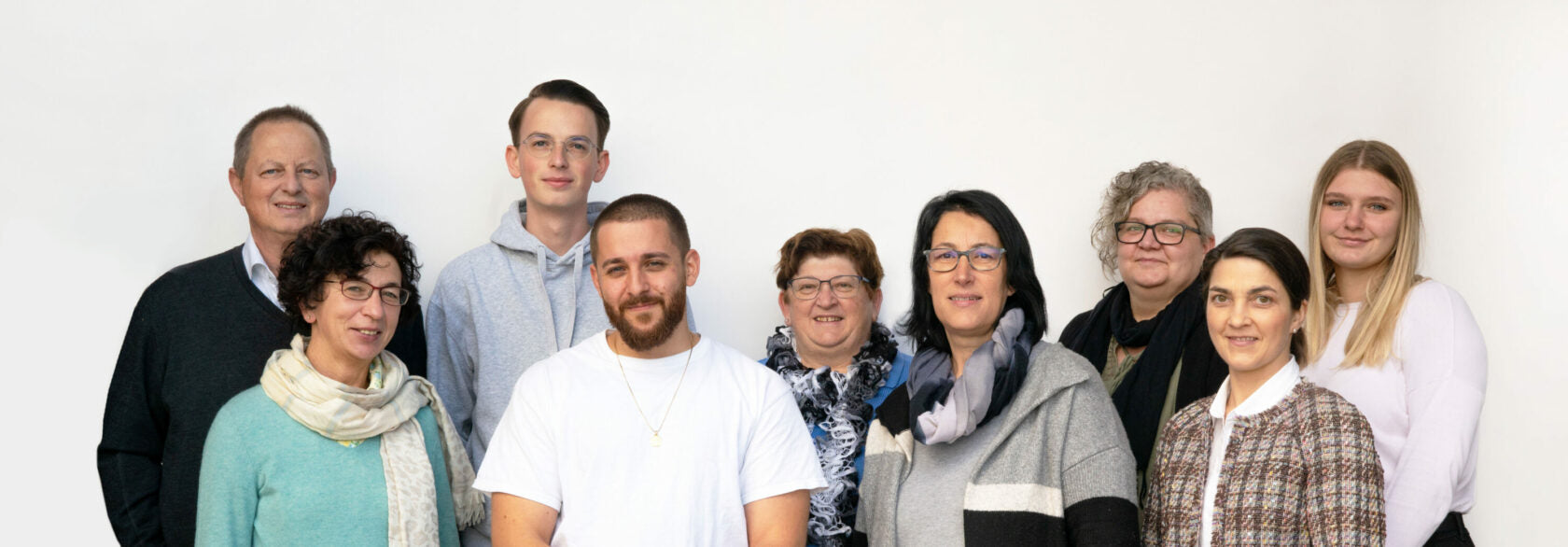
Ritter Blankets
The core range consists of classic natural hair and wool blankets from Ritter Decken, which have been manufactured by Ritter Decken in Weil der Stadt, Southern Germany, since 1994.
Our cashmere blankets, alpaca blankets, camel hair blankets, and wool blankets are well-established in the market and enjoy great popularity. According to Trusted Shops ratings, we are leading in our product range. We are very grateful to our customers for this.
We have added further exquisite and selected products to our core range in the wool and natural hair sector to expand our offering and make it even more interesting.
Ritter blankets can also be purchased in almost all specialist bed stores and from renowned mail-order companies, as well as in selected online retail. This gives you the assurance of acquiring high-quality specialist trade products that should meet your expectations and fulfill fundamental standards regarding quality, workmanship, low pollutant levels in textiles, product safety, and social standards.
The Ritter Blankets Brand
As a manufacturer of high-quality wool and natural hair blankets, we aim to intensify our presence and offer end customers the opportunity to purchase directly from us on our online platform. Additionally, you have the option to visit our blanket outlet to feel the different qualities and receive expert, personalized advice on-site or by phone to find your perfect favorite blanket.
A driving force behind our decision to become active in online retail ourselves is to reduce dependence on and specifications from our trade partners and to secure our continued existence. Only those who strive for a certain independence can develop new prosperous products, secure the necessary financial background, and implement their own ideas.
The focus of our quality lies in the exquisite selection of raw materials, our accumulated relevant cross-generational experience in manufacturing, and a contemporary marketing approach adapted to the circumstances.
We rely on long-experienced employees in our team and support young people in training and graduates from the Merz Akademie, who are integrated into our company and have grown with us in digital marketing.
Furthermore, we collaborate with international trend agencies.
All our products offer you added value. Natural textiles are in vogue and offer incomparable properties and comfort that benefit you. Moreover, they are tested for harmful substances by the Bremer Umweltinstitut on a random basis.
In manufacturing, we refrain from using plasticizers and synthetic aids. Ritter blankets are thoroughly washed with natural soap and are safe to use. For most blankets, we use the natural colors of the animals, which are undyed. If dyeing is done, we only use the highest quality dyes.
We would like to sincerely thank all customers who support us and purchase and use our high-quality wool blankets and natural hair blankets.
Your Christian Ritter & Team
Management

Dipl. Ing. (FH) Christian Ritter
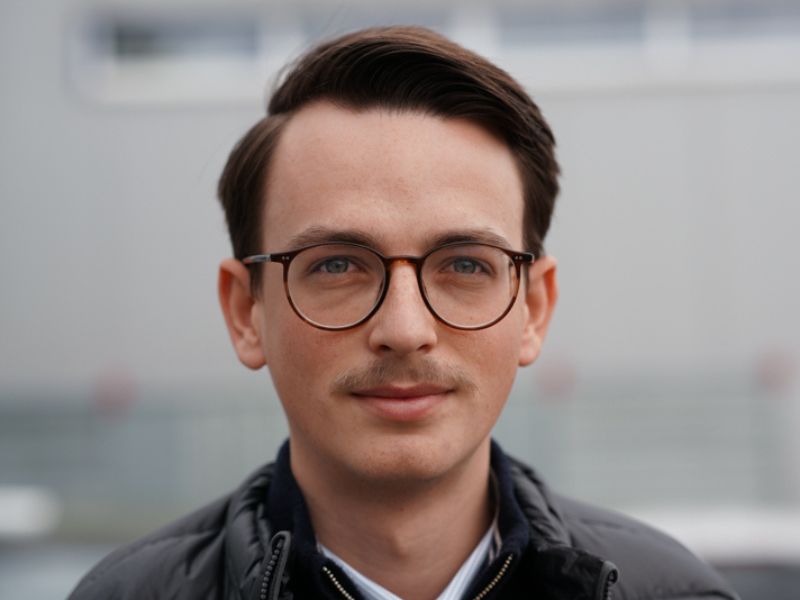
Maximilian Ritter
Our team
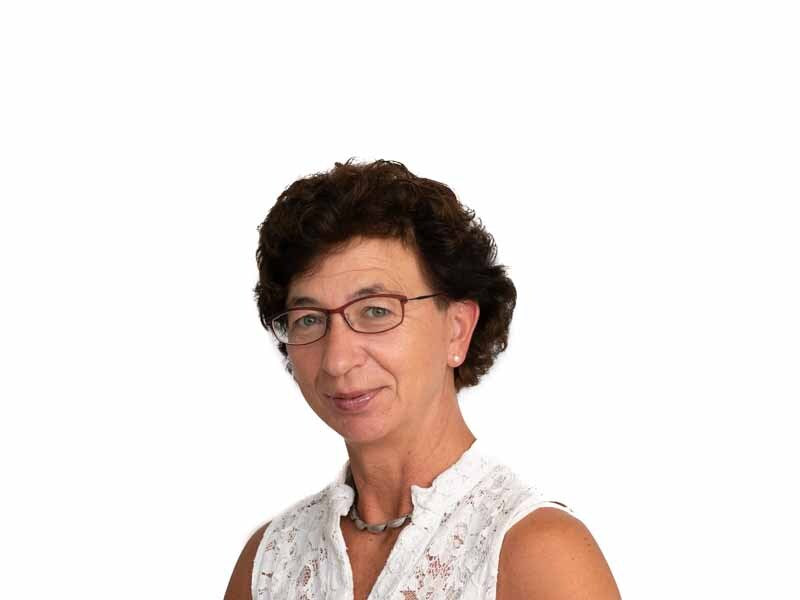
Maureen Gössler
Assistant to the Executive Board
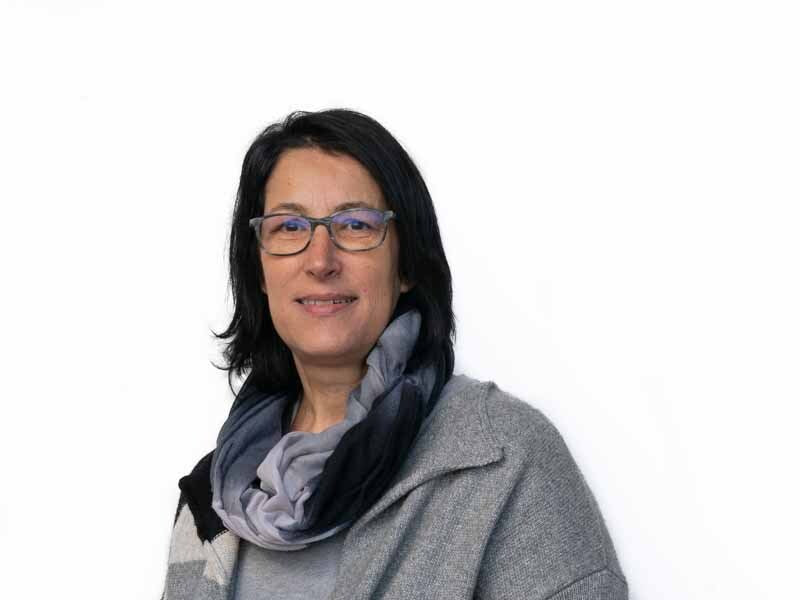
Maria Ott
Office
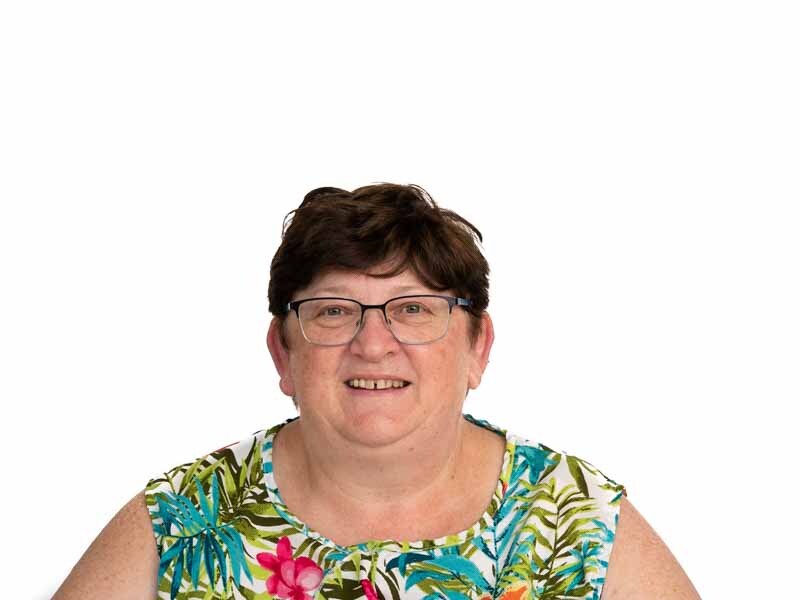
Eva Weber
Ready-to-wear

Christine Gelo
Assembly
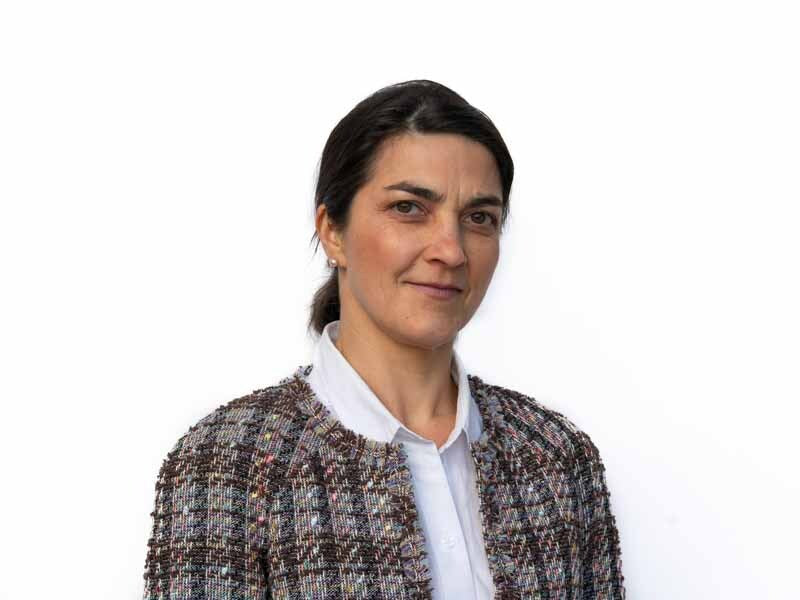
Natalia Sotnikov
Ready-made Garments

José Bastista
Warehouse
Unique Selling Points of Ritter Blankets
18 reasons why our natural fiber blankets are the right choice if you are looking for high-quality wool blankets and natural fiber blankets.
1. We are a manufacturer – made in Germany (learn more)
2. Intergenerational experience and know-how in manufacturing
3. Made in Germany (most products)
4. Gentle manufacturing process
5. High quality
6. We are experts in raw materials (alpaca, cashmere, camel hair, mohair, wool, cotton)
7. Owner: Dipl. Ing. (FH) Textile Production
8. Fast delivery within 1-3 business days
9. Random pollutant tests at the accredited independent Bremer Umweltinstitut (Bremen Environmental Institute)
10. Animal welfare and protection are important to us (since May 2020, we only process mulesing-free wools)
11. Personal, individual, and free consultation. (on-site or by phone)
12. Free sample shipping, if available
13. Secure and convenient payment methods: Paypal, Amazon Pay, credit card, Sofortüberweisung (instant bank transfer) and purchase on account
14. Wool blanket outlet (with us, you can feel all qualities, choose in peace, and find a bargain or two)
15. High delivery capability. We permanently stock approx. 6,000-8,000 blankets.
16. We won't leave you stranded even after your purchase
17. Personalization with your name, if desired
18. Gift wrapping available
Philosophy
They still exist, valuable companions, classics for sleeping and living.
We have made it our main goal to offer you an exquisite selection of natural material living and sleeping blankets, which are made for you to pamper your senses,
do your body good, and ensure healthy sleep.
The necessary ingredients come from nature's treasures. With their natural, positive properties, they are inherently the first choice if you are discerning and looking for the best for yourself.
You will simply feel comfortable under our wool blankets made of pure new wool, fine alpaca, exquisite cashmere, soft yak undercoat, or the particularly temperature-regulating camel hair.
We want to pamper you with our natural hair blankets and hope that our wool blankets will be a valuable companion that you won't want to miss.
Ritter Decken manufactures this pure natural product with love and dedication.
As a manufacturer, we have extensive expertise and know about natural hair blankets and how to gently and correctly produce them from exquisite ingredients so that they can fully develop their positive properties.
Therefore, we can also advise you on our products and offer you the opportunity to shop in our shop.
Our intention is not to offer you countless products and categories in the hope that you will find something suitable.
We largely limit this offer to natural hair and wool blankets that we personally know, produce, and use ourselves.
For your information, we have generally created a data sheet for each of our blankets, with the help of which you can get an initial orientation on the product properties and differences of our wool, natural hair, and quilted blankets.
If you have any additional questions, we will be happy to answer them by phone.
In addition to manufacturing high-quality natural hair blankets with the best physiological properties, we see you at the center of our efforts. This includes for us:

100% natural fibers

Fast delivery (1-3 days)

We know:
Only a satisfied customer will recommend us and make repeat purchases.
“Good business is business that one would be happy to do again.”
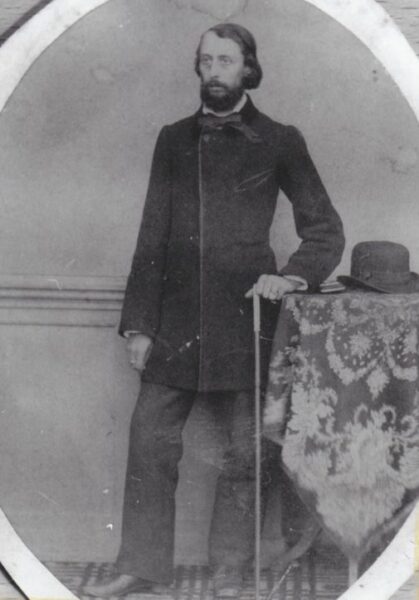
Ritter Blankets – our family tradition since 1766
Quote
“When we look back, we see what we did well and what we did poorly. We use insights in the present, and the future gives us the answer. Repeated mistakes are not coincidental, but our carelessness.”
Author unknown
Foreword
The owners of Ritter Blankets are descendants of the Uebel family.
This overview is dedicated to the tradition and history, as well as the stories passed down by my grandmother Gertrud Ritter, née Uebel, my father Friedrich Ritter, his two brothers Gerhard Ritter and Erwin Ritter, as well as the descendants of the Uebel family, particularly Mr. Hubert Uebel, but also Dr. Klaus Kogler and Ms. Friedel Mark. The Rossbach local history book and reports from my relatives provided me with valuable information for my research. Some aspects are still present from my own memories, stories, and experiences. One should not forget that two world wars, a global economic crisis, and current developments have significance for the future.
History and tradition have been personally re-examined and documented for me. They are owed in deep gratitude to my father Friedrich Ritter and all descendants.
The Uebel family originally came from Tyrol and the Salzburg region. They were initially farmers.
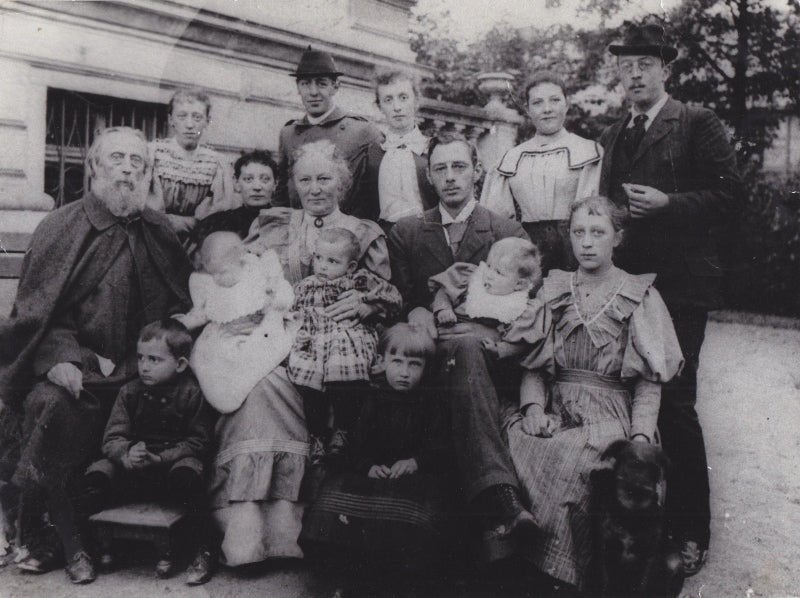
1st Generation
Johann Paul Uebel (22.07.1733-07.04.1773), by profession papermaker and weaver, resident in Roßbach (today Hranice in the Czech Republic, formerly the Austro-Hungarian Monarchy). "Roßbach was then a small, inconspicuous village and is said to have received its name from the fact that in ancient times the Sorbs watered their horses here by the stream, back when the Imperial Knights of Neydberg built a castle in the area."
Johann Paul Uebel devoted himself to cotton weaving and was already selling his goods in 1766 at the Pilsen market (7 children).
Without knowledge of the Jacquard machine, elaborate fabrics with woven patterns were already being produced in the 18th century. These were highly sought after and well paid for on the market.
2nd generation
His son Christian Friedrich Uebel (26.12.1766-13.09.1816) was a master weaver by profession. Note: In 1796, he was master of the Aš cotton weavers' guild and by 1810 he was operating 12 looms. (7 children). In 1818, a harvest failure led to a famine in the upper Vogtland.
3rd generation
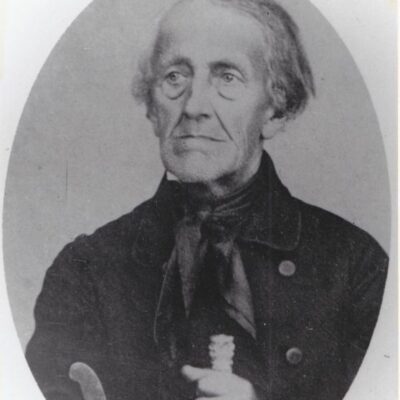
His son, Johann Christian Uebel (July 14, 1794 - September 6, 1866), went on his journeyman years, as was customary at the time. There were no railways yet, and post horses and carriages were expensive, so he walked from place to place. His destination was Berlin, and he reported on the construction of the Schauspielhaus (1819-1821), the Schloßbrücke (1819-1824), the local industry, especially silk manufacturing, where he also found employment.
Rich in experience, he returned to his home village of Roßbach. His father had already died (on September 13, 1816). His grandfather now continued his father's weaving business.
The goods were taken to Pilsen themselves and sold there. Johann Christian Friedrich Uebel worked as a textile manufacturer (6 children).
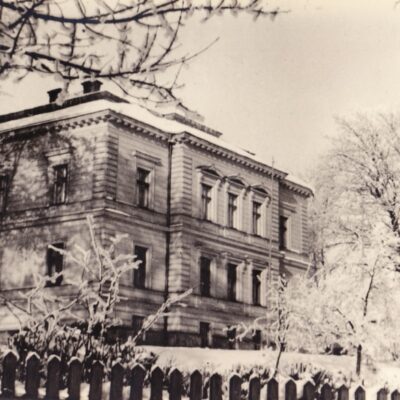
Uebel Villa
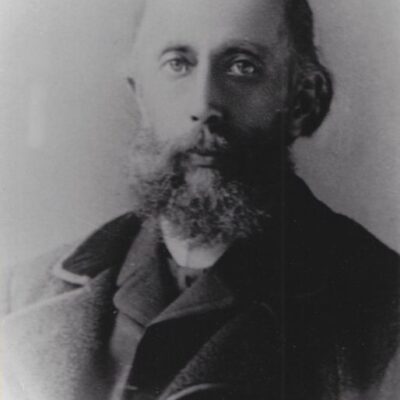
Johann Christoph Uebel 1829-1899, textile manufacturer and builder of Villa Uebel - His older brother Johann Gottlieb Uebel (04.10.1817-07.02.1872), married Wilhelmine Künzel (26.03.1821-30.05.1851), one of 6 daughters of Joh. Künzel (renowned textile manufacturer) and continued his company after Joh. Künzel's death (1793-1849).

4th Generation
Gottlieb Uebel was initially an export representative for his father-in-law, Johann Künzel, in Hamburg. He then founded his own business in Roßbach and brought his youngest brother, Christoph, who was working in Vienna, into the business. This led to the formation of the company Gebrüder Uibl, which was registered in the Eger trade register in 1855 (and existed until 1945/46). Its main branch was in Rossbach, with a national license for the production of wool and cotton goods. At its founding, the company employed 132 hand looms and is considered the successor company to Johannes Künzel, Gottlieb Uebel's father-in-law, who died after 1849 without any sons.
Johannes Künzel is referred to as an Imperial and Royal privileged cotton spinning manufacturer in Rossbach. This designation refers to the cotton spinning mill he founded in Thonbrunn-Neuenteich near Rossbach.
4 children. His daughter Bianca Emilie (1846-1898) married a Mr. Schönherr. Their shared daughter Emmi (1870-1922) married Julius Meinl II. Their son, in turn, was Julius Meinl III (1903-1991).
5th Generation
Johannes Künzel had 6 daughters and one son, who mainly studied astrology but did not continue the business.
In 1856, the two Uebel brothers founded the cotton and virgin wool factory Gebrüder Uebel. The company grew steadily.
In the second half of the 19th century, a unique weaving mill for exotic fabrics for export to distant countries, particularly India, developed, and the product range expanded to include tablecloths and curtains.
Johannes Ritter (17.03.1819-25.05.1890), weaver and pattern designer, was a contemporary and presumably worked for Gebr. Uebel in Rossbach.

Adolf Ritter (1857-1945)
was a merchant and commercial traveler from October 1881-1935. He handled the export for the company Uebel, later Adoros. Mr. Adolf Ritter worked for Gebr. Uebel for over 54 years and was a very good salesman. In the K. u. K. Monarchy, he traveled all over Austria-Hungary. Initially, when he was traveling, orders were sent to the company by post.

Friedrich Karl Uebel
Johann Christof Uebel's (d. 1899) two eldest sons must have joined the company as his successors around 1890 and took charge of its further development.
Friedrich Karl Uebel (25.02.1872-17.02.1934), Industrialist
(7 children, including Gertrud Ritter (1901-1988) née Uebel, the grandmother of the current company owner Christian Ritter).
The Uebel family
Picture of the Uebel family around 1898, on the far left Johann Christof Uebel, on the far right his son Friedrich Karl Uebel, one of his two successors
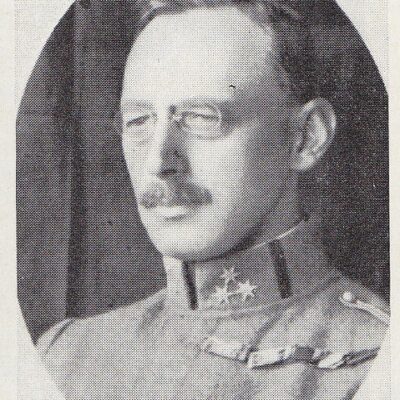
Karl Robert Hubert Uebel
(30.03.1874-23.11.1939), 1 child.
In addition to scarves, cloths and tablecloths, the first carpets were probably woven around 1900.
With the advent of mechanization around 1900, carpets were also produced. The area around Asch, Adorf and Rossbach became the center of the Austrian textile industry.
Brand name Adoros
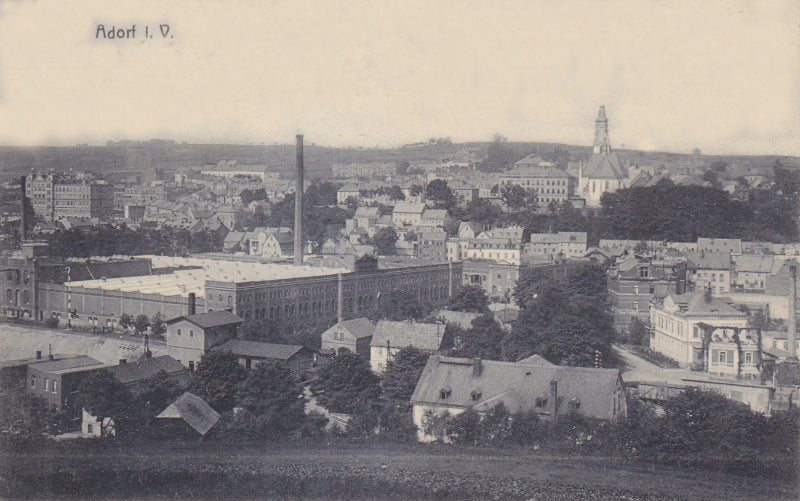
The postcard from 1906 still shows the company Claviez Kunstweberei und Teppichweberei (Art Weaving and Carpet Weaving) in Adorf in Saxony-Vogtland. In 1926, the Claviez company ran into financial difficulties and was bought by Gebr. Uebel. At that time, 2500 employees were working there and the newly acquired company was about 5 times larger than the parent plant in Rossbach.
From this point on, the brand name Adoros was created. An artificial name derived from the place names of the two factories in Adorf and Rossbach.

Adoros Share
Share from 1928 of the Carpet and Textile Works in Adorf, Adoros (during the Great Depression).
Although the Great Depression was difficult, Adoros managed to establish itself as one of the largest carpet companies in Europe.
Without knowledge of the Jacquard machine, elaborate fabrics with woven patterns were already being made in the 18th century. These were highly sought after and well paid for in the market.
6th Generation
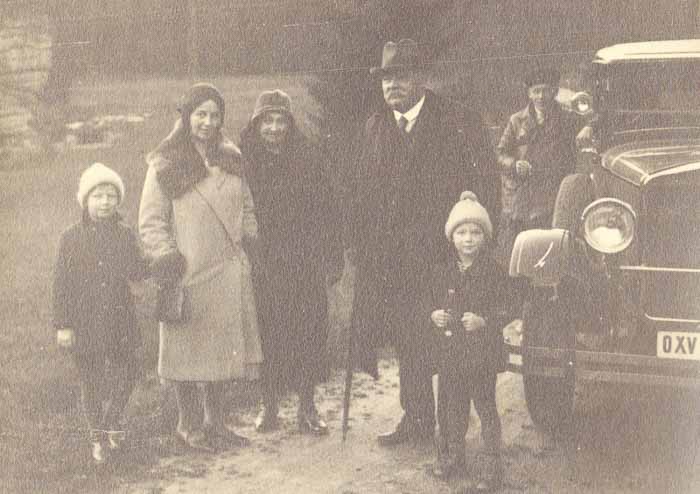
Gerhard Ritter, Gertrud Ritter, Linda Ritter, Adolf Ritter, Friedrich Ritter, chauffeur and car of the Uebel family
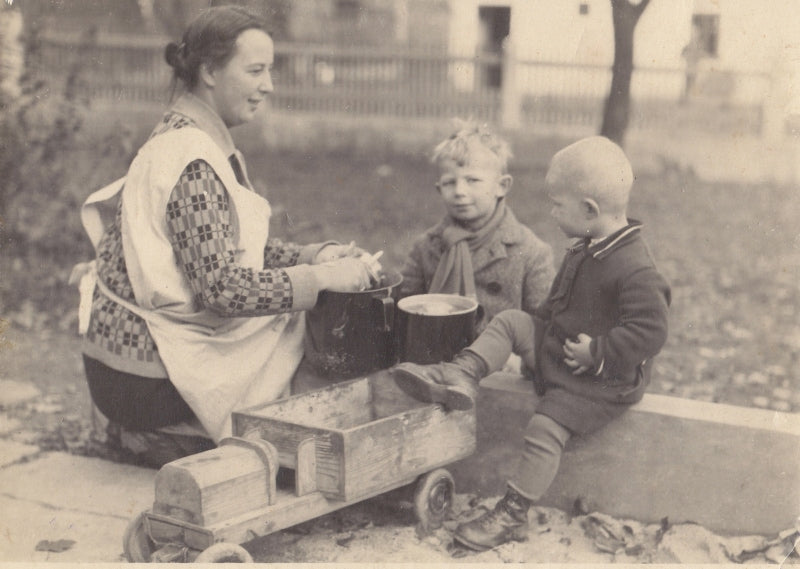
Ms. Gertrud Ritter
Next, the children of Friedrich Karl Uebel joined the company. Traditionally, the two eldest brothers were always appointed as successors. (Werner, Karl, Erich)

Werner Uebel (1898-1933)
was multi-talented. He was both an entrepreneur and a technician and introduced the double-face pile weaving technique, where 2 carpets are woven one above the other and the pile is separated by a knife, into carpet manufacturing. His hobbies were music (violin) and racing (car and motorcycle). Rather quiet and thoughtful by nature, Mr. Werner Uebel conducted the negotiations with the banks in Prague when Kunstweberei Claviez was acquired in 1926. In 1933, Werner Uebel died in a car accident.
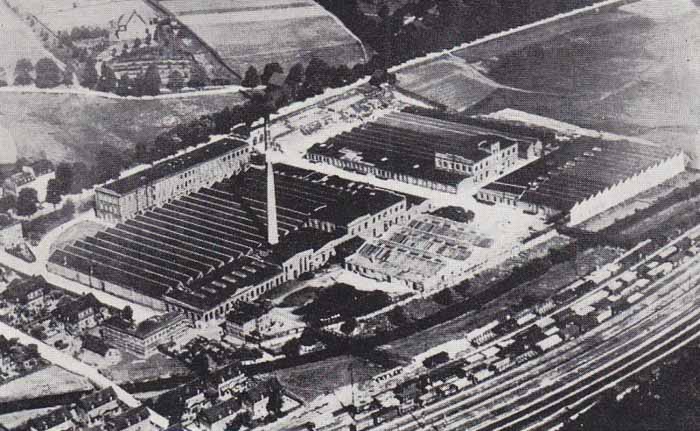
Adoro's Works in Adorf 1926-1945
The two factories in Adorf and Roßbach, each with its own spinning and dyeing mill, employed more than 3,000 workers and employees in 1939 and had grown into the largest carpet factory in continental Europe.

Karl Uebel 1906-1966
Doer, entrepreneur, leader. After Werner Uebel's death, his younger brother Karl Uebel took the helm. Karl Uebel was an experienced yet impulsive businessman.
Erich Uebel 1912-2005
The Second World War abruptly interrupted this upward trend, and the end of the war also meant the end of both enterprises. Both companies were expropriated and dismantled, and the families were expelled.
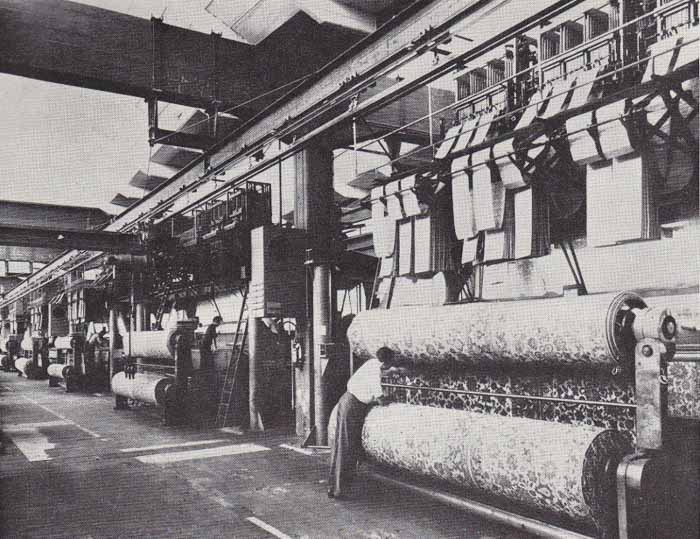
Adoro's Production
Visit of the Governing Mayor of Berlin, Klaus Schütz, on 22.05.1969, with Erich Uebel, Ms. Geier as the oldest weaver, 74 years old, and Ms. Weiß
1945 End of the War
Expulsion and expropriation by the victorious powers followed. There was a new demarcation of borders in the Sudeten German areas, which were largely resettled (until then 90% German-speaking and German-cultured population). The victorious powers approved the founding of Czechoslovakia. The Beneš Decrees were proclaimed by the exiled Prime Minister Beneš of the newly founded Czechoslovakia. Approximately 3 million Sudeten Germans became stateless in Czechoslovakia and lost their homes. Due to the rigorous expulsion, approximately 277,000 Sudeten Germans lost their lives.
Many of them were defenseless women and children and elderly people. A large proportion of the conscripted men from these areas were scattered across the theaters of war at that time, had been captured by the victorious powers at the end of the war, or were later directly released to West Germany.
To vitalize the population vacuum in these areas of Czechoslovakia since 1945, marginalized and mostly unskilled population groups were settled. Due to the reorientation towards the East, these areas experienced economic decay and decline to this day. Since the opening towards the West, there have been some improvements in living conditions there since 1995. The infrastructure has improved significantly since then.
However, not the borderland, but the larger industrial cities like Prague, Budweis, and Pilsen benefited most from this.
RESET Button after the war in 1946, the ADOROS era was re-established in West Berlin.
Karl Uebel first fled to England thanks to good connections and planned to found a new carpet company in England, but he returned to Berlin around 1951 and, with the help of ERP funds, then 1 million Marks, founded the Uebel (Adoros) carpet factories in West Berlin Spandau in 1954, later at Juliusturm 14-38. A condition for his return (the destroyed Berlin was to be rebuilt) was the guarantee of the Berlin Senate, which was redeemed after only 6 years.
Mr. Karl Uebel had set himself the goal of re-establishing a global company, and he and his brother Erich Uebel planned accordingly generously. The negotiations conducted in 1953 with the Berlin Senate and the Berliner Industriebank, which managed the ERP funds placed in Berlin on a fiduciary basis, were successful, and in April 1954, Adoros Teppichwerke Uebel K.G. was launched in Berlin Spandau in rented and partially destroyed halls of the BMW company (Bayerische Motoren-Werke). The favorable development already necessitated the rental and repair of further BMW buildings in 1956/57. Then, land was acquired opposite these facilities, and a spacious new building was erected in 1960/61, which provided space for new looms and finishing machines, for a new spinning mill and a new dye works with the most modern equipment, and for about 1000 workers and employees. Now the entire production process from raw material to finished product was again in one hand. This healthy development was also necessary, however, as the lease agreement with BMW was expiring.
Therefore, three more large buildings had to be erected on the new property in 1961, 1967, and 1969, and with that, the new large enterprise had reached imposing dimensions. The workshops covered an area of 30,000 square meters. The Adoros company thus belonged, as before the war, to the leading companies in its industry, and its products were again exported worldwide. The velour carpets were made of 100% pure wool yarn and were produced on the most modern looms of the time using a special weaving process. The production program included 15 different qualities of carpets, rugs, bridges, bedside rugs, and runners, both in oriental and modern patterns, a wide-ranging assortment, from inexpensive utility carpets to the highest quality Kirman Schah, which, with 650,000 knots per square meter, was one of the finest and most densely woven carpet qualities on the world market.
Mr. Karl Uebel, who primarily brought about the reconstruction with his extensive knowledge and valuable experience, died in 1966 three days before his 60th birthday.
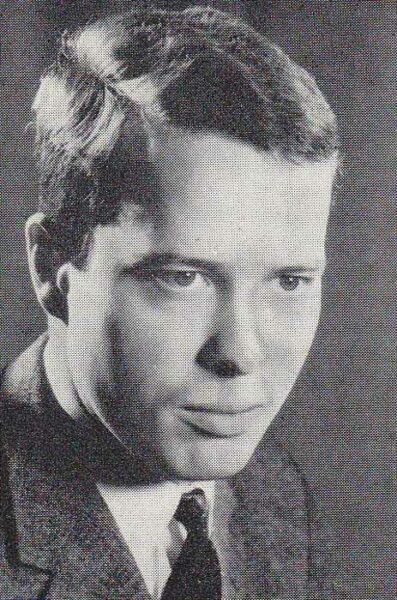
7th Generation - Wolf Dieter Uebel
The management then passed to his younger brother Erich Uebel and his son Wolf Dieter Uebel, his brother-in-law Ing. Hermann Hilf, and other employees such as Ms. Weiss (authorized signatory) in responsible positions.
In the era of the economic miracle, from 1955-1973, German industry benefited.
At that time, only a few people could afford genuine hand-knotted carpets.
Adoros filled this gap with its machine-woven carpets using jacquard technology, which matched the patterns of classic hand-knotted carpets and offered an inexpensive, high-quality, and affordable alternative to hand-knotted carpets.
As prosperity increased, hand-knotted carpets also became more affordable and cheaper. The demand for high-quality machine-made carpets decreased.
New, more affordable techniques such as tufting in industrial and broadloom carpets emerged, and commercial carpets became increasingly cheaper with new technologies.
Investments in new technologies and innovations in carpet manufacturing were neglected. Ultimately, sales and profits declined in the 1980s, the worsted spinning mill was divested, Ms. Weiss was paid out, the land was sold and subsequently leased, which initially provided sufficient liquidity for several years.
Around 1986, a strategic decision was made to pull the emergency brake to avoid indebtedness.
The machines were sold in time, and the company was shut down before it would have gone bankrupt.
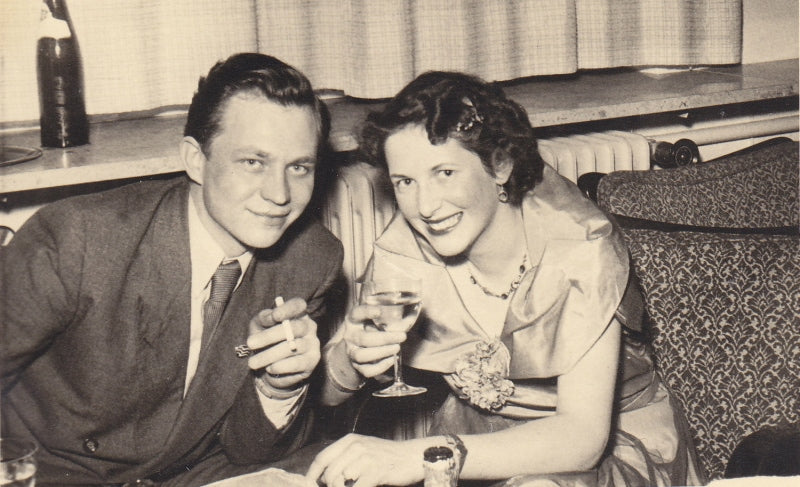
Fritz and Cläre Ritter 1951
Mr. Fritz Ritter was still very young but was able to pass his final examination at the State Vocational School for the Textile Industry in Asch on July 1, 1944. He was subsequently drafted into the Luftwaffe and trained. While still in training and without combat deployment, he became a cadet and was taken prisoner by the Americans in Italy. According to his accounts, he had fond memories of this time.
His tasks there included painting Jeeps (one of his ideas was metallic green), which the Americans absolutely loved. Every driver wanted this new look for his Jeep. Or he helped in the kitchen making pancakes for breakfast. He was also allowed to draw the girlfriend of an American officer because he was good at drawing. In return, he received free leave and some money, which he invested in a new pair of shoes.
After about 2 years, some of the prisoners with some mountain experience decided to escape over the Alps from Italy to Germany with the help of ropes. My father was an enthusiastic pilot, but he was not good with heights. He therefore preferred to remain in custody with the Americans but was released a short time later to Erlangen-Bruck, where he met his mother, his grandmother, and his two brothers again.
His father, Gustav Ritter, unfortunately made the mistake of traveling to his former homeland in Rossbach, where he was imprisoned and then held captive in Bautzen until 1955.
Mr. Friedrich Ritter, according to his two brothers the most talented, took the initiative and initially made rag rugs on a self-built loom. From 1950, he produced and sold cotton towels in Tüschnitz with used mechanical looms and provided for the livelihood of his two brothers and his mother, Gertrud Ritter.
In 1951, he met my mother, Cläre Ritter, née Christlein.
They both married in 1951.
In addition to 2 weavers, his two brothers Erwin Ritter and Gerhard Ritter, as well as his mother Gertrud and his grandmother, helped in the business. After his release from Bautzen, his father Gustav Ritter also joined them.

Ritter Family 1957
1957 Cläre Ritter, Ursula Ritter, Fritz Ritter, Monika Ritter
When Fritz wasn't working or lying under the looms to repair them, he could be found at the airfield. Gliding was his great passion. He was a gliders and powered aircraft instructor.
Then, when his "Great" Uncle Karl Uebel visited around 1962 and they both discussed the business and went through the books, he advised my father to be released from his customer orders. He should rather come to Berlin to Adoros. The production of cotton towels was not profitable.
However, Mr. Fritz Ritter initially wanted to seek his own fortune and first went to work for 2 years at Wolldeckenfabrik Weil der Stadt AG and temporarily gave up his self-employment. Presumably, he also did not want to tolerate his despotic and dominant Uncle Karl Uebel in Berlin, even if the latter valued him greatly. The initially planned 2 years at Wolldeckenfabrik Weil der Stadt AG then turned into 30 years.
With great effort and commitment, under the technical direction of Mr. Ritter, Wolldeckenfabrik Weil der Stadt became a leader in natural hair blanket production. Mr. Friedrich Ritter contributed significantly to the reputation and standing of the company Wolldeckenfabrik Weil der Stadt AG.
He got along excellently with his colleague Mr. Seeger, who was responsible for the fabric sector. Mr. Ritter also appreciated the commitment of Dr. Rose Schnaufer on the board at the time. In addition to his salary, he received commission payments as recognition for his new developments, and he was later also given responsibility for raw material procurement.

Certificate
In addition to his studies and basic knowledge of raw materials, Mr. Friedrich Ritter was the most capable practical mentor for his son Christian. With his 30 years of experience, he passed on crucial insights regarding raw material purchasing, spinning, weaving, and the design, production, and finishing of natural hair blankets. He was very innovative and had a wealth of his own ideas (patents for the production of voluminous natural hair blankets) that were used for series production.
Mr. Ritter, in collaboration with the company Müller, developed a new finishing machine for
opening pile loops with cutting segments from surgery. A self-made model served as a prototype. The finished machine was fully functional in a separate department, worked perfectly in practice, and was very impressive.
Due to changes in ownership in Weil der Stadt, high indebtedness, unsuccessful management, and the new owner's primary interest in the company premises, the framework conditions became more challenging.
Initially, in 1994, Mr. Ritter Senior utilized his expertise in his former homeland, present-day Czech Republic, where production possibilities existed.
Initial attempts were promising. However, there was no interest from the sales department of Wolldeckenfabrik Weil der Stadt AG in integrating new products into the existing price range.
This was the decisive point to become active oneself. In the wake of the closure of the spinning mill and further austerity measures at Wolldeckenfabrik Weil der Stadt AG, and due to the high level of indebtedness of Wolldeckenfabrik Weil der Stadt AG, there were no longer any favorable future prospects from the perspective of father and son.
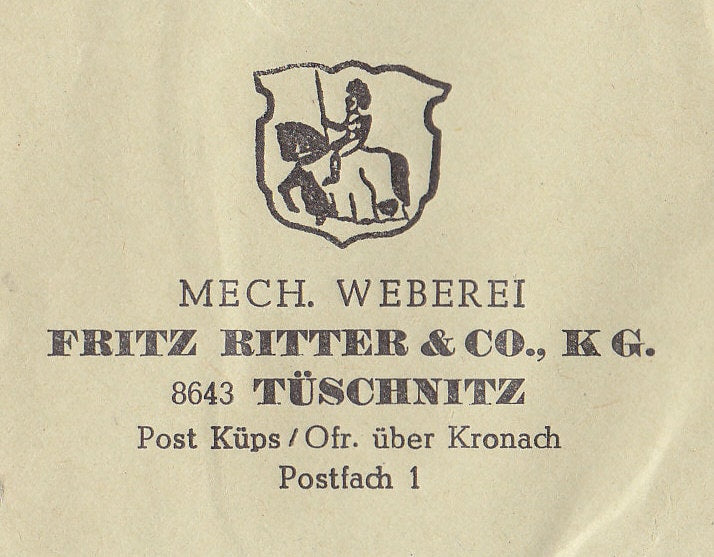
Fritz Ritter Weaving Mill
From 1950, in Tüschnitz, he produced and sold cotton towels using used mechanical looms, providing for his two brothers and his mother, Gertrud Ritter.
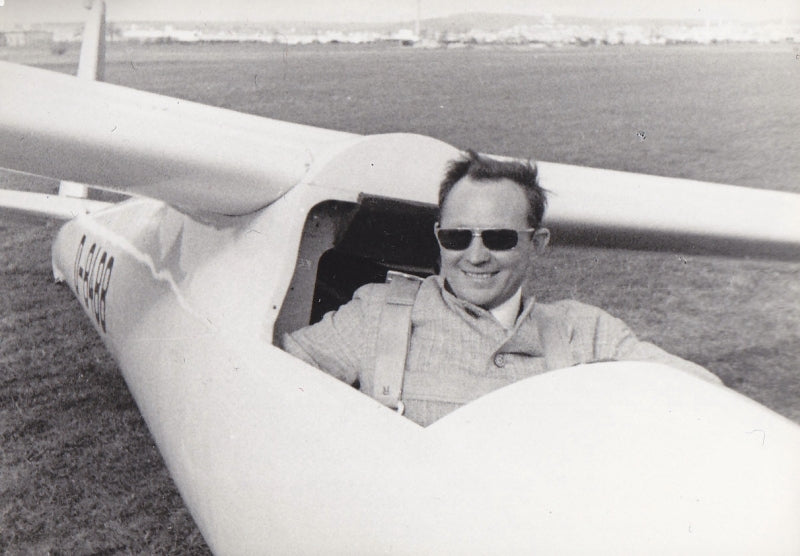
Fritz Ritter as pilot
His great hobby was glider flying. In addition to his profession as a textile engineer, Mr. Ritter was a glider and power pilot instructor.
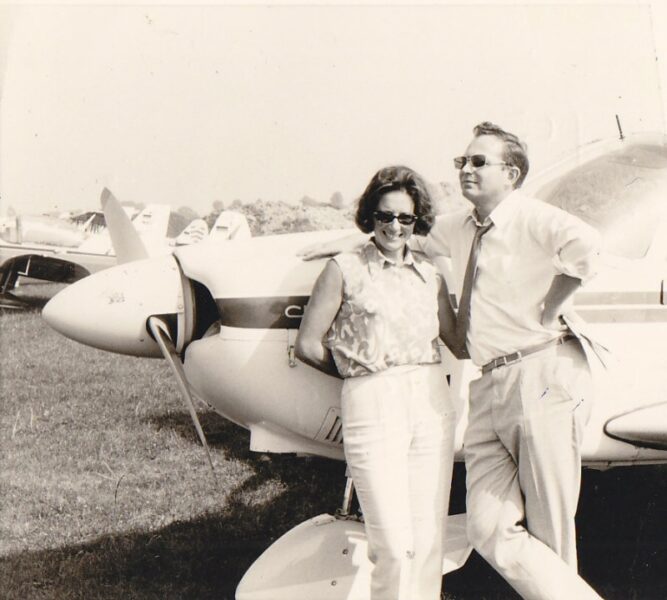
Fritz Ritter
Claire and Fritz Ritter at his hobby, gliding.
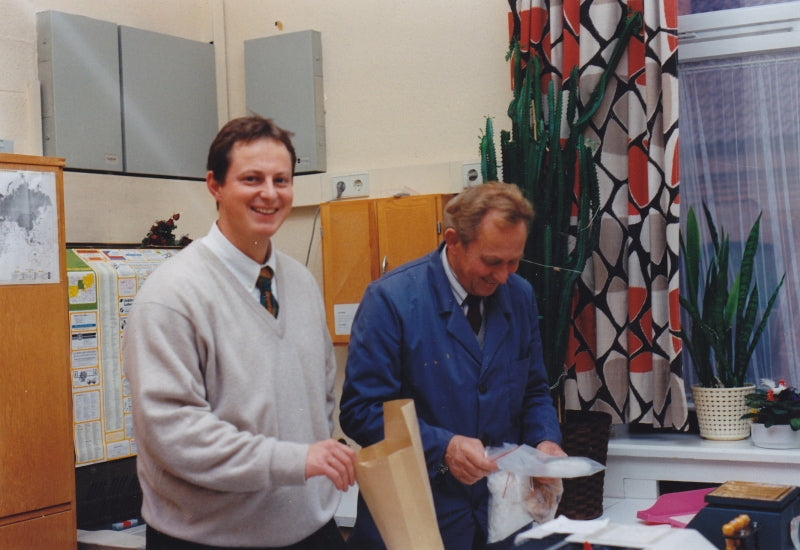
8th generation
Mr. Christian Ritter (Dipl. Ing. FH) was able to take on this task as a successor, initially with his father and then independently, after studying at the FH Münchberg from 1991-1994. In advance, Mr. Christian Ritter was able to gain relevant raw material experience during his two practical semesters by assisting and working in 7 different English companies in Bradford, the textile center in England since the 19th century. There he learned about the dehairing of noble hairs at Joseph Dawson, wool trading at H. Dawson, the cashmere trade at Seals International, wool washing at Jarmain, and the sorting of mohair types at Laycocks. In the laboratory, he learned about the practice of the corresponding testing procedures.
Founding of Ritter Decken
Mr. Friedrich Ritter took the quote: "better a small king than a great servant" seriously and took the initiative. With his extensive know-how, he wants to prove himself professionally again after his retirement at the youthful age of 65.
Ritter Decken was founded on April 30, 1995, initially as a sole proprietorship by Mr. Friedrich Ritter, with Mr. Christian Ritter assisting in production. Further small-scale productions followed in the same year.
Together with his son Christian Ritter, new paths are being taken back to self-employment. The term "engineering by Ritter" is coined.
To further improve quality and with the aim of spending more time in sales, pre-production (spinning and weaving) was carried out in the Czech Republic, but final finishing was increasingly done by Calwer Decken und Tuchfabriken AG in Calw from 1999 onwards.

After initial joint trials, natural hair blanket production was started at the Alma company in South Bohemia. Sales were slow in the first year, but in subsequent years production steadily increased until approximately 20,000 natural hair blankets/year were produced in 1998. Mr. Christian Ritter independently managed production at the manufacturing site (mostly in 2 shifts) and became an equal partner in Ritter Decken OHG. Sales, warehousing, the office, and finishing have since been located in Weil der Stadt, Merklingen district.
Some sales representatives, formerly from Weil der Stadt and Calw, joined us, and the successes gave the company owners a positive outlook.
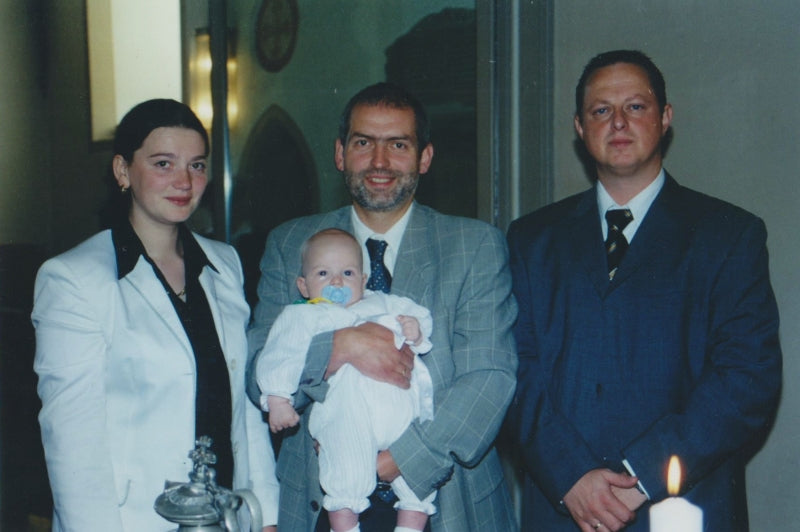
Christening of Ludmila Ritter
Thanks to the high-quality machinery in Calw, new finishing methods were developed together with Mr. Will, who was then the Head of Finishing at Calwer Decken und Tuche AG.
Mr. Friedrich Ritter, arguably the most capable mind in natural fiber blanket manufacturing at the time, and Mr. Will, arguably the best mind in fabric finishing at the time, formed an ideal team that pioneered and developed new finishing methods for blanket production at Calwer Decken und Tuche AG.
The blankets produced in this way, including 100% cashmere, also made their way to Japan, where they were sold by export manager Mr. Obermaier with conviction as "the best in the world."
In autumn 2002, Mr. Ritter Senior passed away. Mr. Christian Ritter has been running the company as a sole proprietorship ever since.
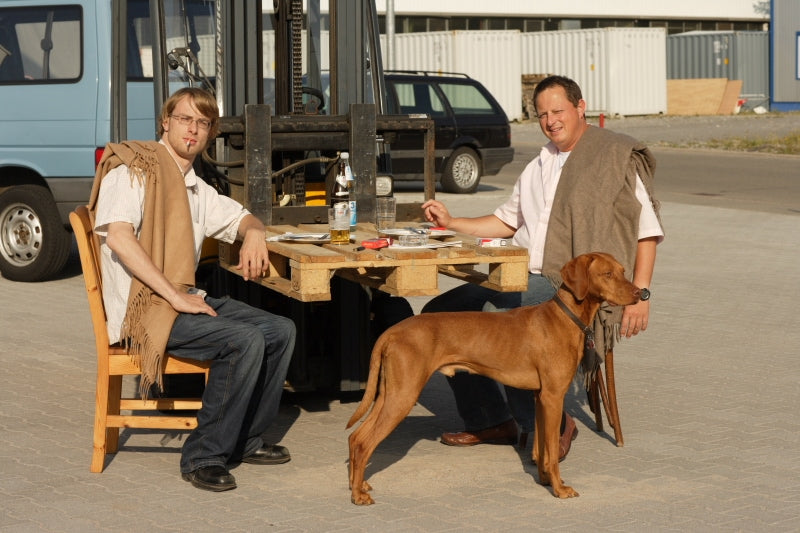
Creative break with his nephew
In 2008, following the closure of the Calw production site, several finishing machines were purchased to enable continued high-quality production.
Mr. Will (formerly head of finishing at Calwer Decken und Tuche AG) was a great help in commissioning the purchased machines at the new production site.
Ritter Decken e.K. now produces at several locations in Germany. Spinning takes place in the new federal states, weaving in Upper Franconia, and finishing in Franconia and the Upper Palatinate, with on-site production support. Finishing and sales take place in Weil der Stadt.

Ritter family
Summer 2012, Maximilian Ritter, Eike Gössler, Maureen Gössler, Christian Ritter, Vincent Gössler and dog Nico
Cotton towel
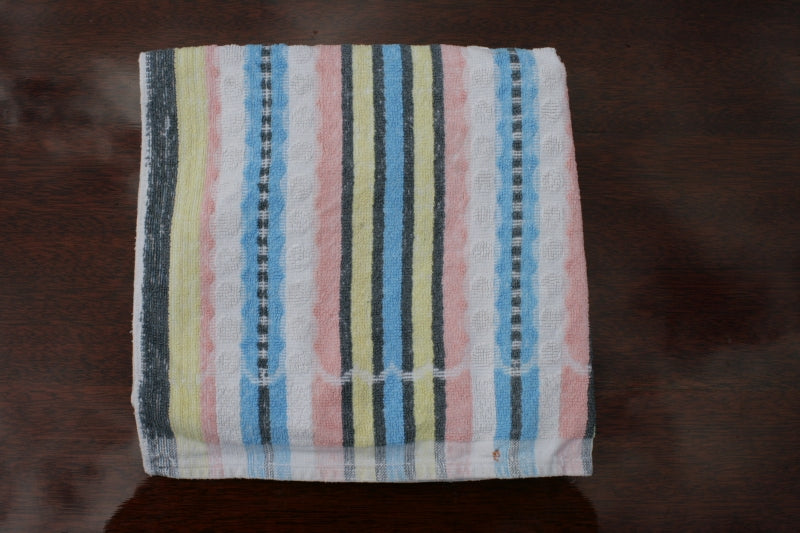
The image shows a 100% cotton jacquard towel, which has been in use until today and was made by Mr. Ritter around 1955. True Indanthrene dyed. Only long-staple combed cotton from Egypt was used. After 60 years and countless washes, the signs of age are visible, but otherwise, it is still in perfect condition.
2015
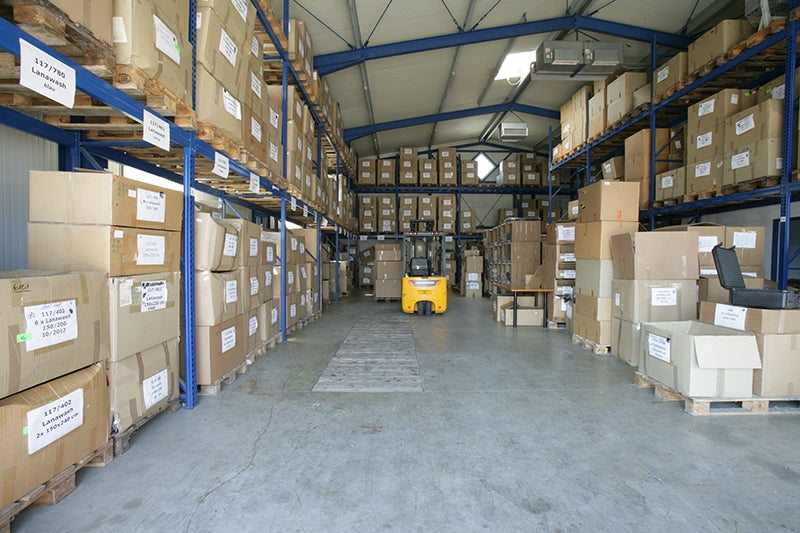
Ritter Blanket Stock
To ensure prompt delivery, approximately 8000 blankets are kept in stock and bound on-site.
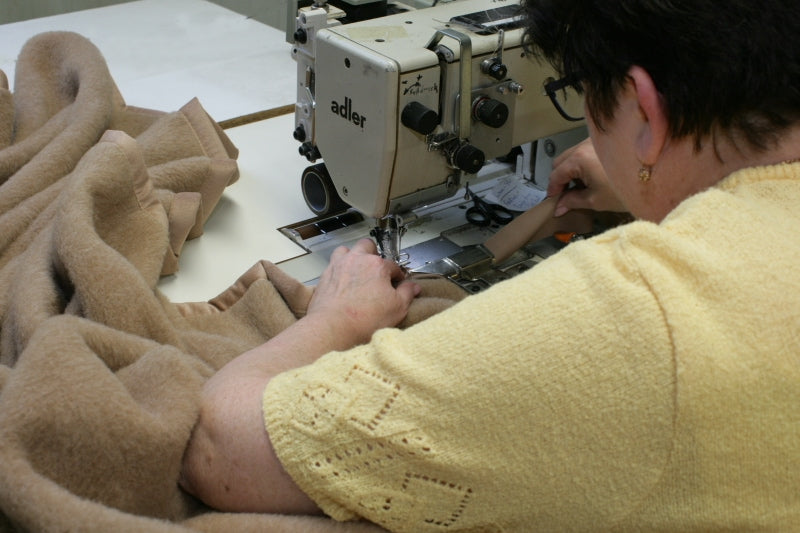
Finishing of natural hair blankets. Ms. Weber, a trained seamstress, has been expertly binding the blankets for years.
