New Wool
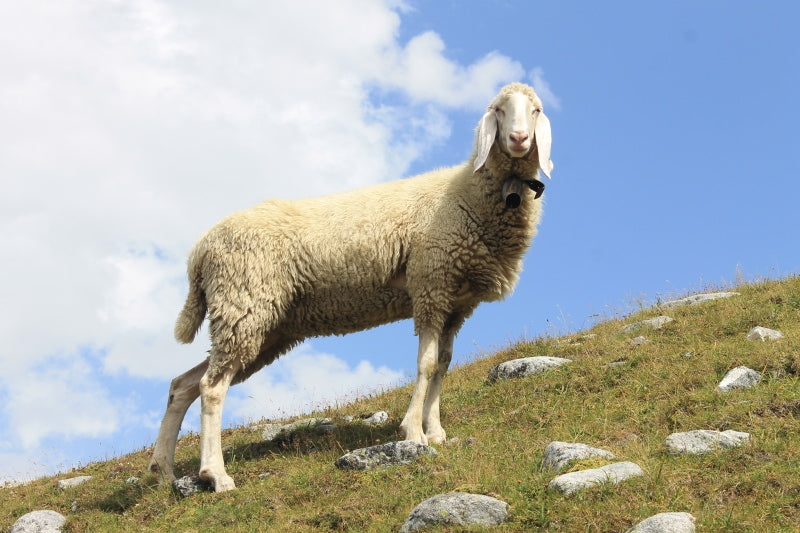
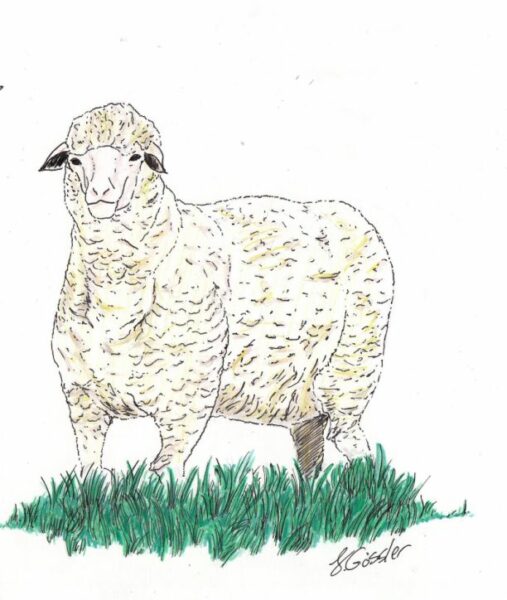
New wool is wool shorn from a living sheep. The main producing countries are Australia, Russia, New Zealand, and South America (Chile, Argentina, Bolivia), and, at some distance, Great Britain. The coarser and more durable wools, such as those found in England, for example, can be processed into tweeds and blazers.
All countries not listed play a rather subordinate role as "wool suppliers," even though sheep exist almost everywhere. In addition to wool production, sheep are also kept as livestock for meat, milk, and leather production. Sheep are probably humanity's oldest domestic animal. They were likely domesticated 9,000 to 11,000 years ago.
Relevant for our blankets are the finer wools from Australia, with a fineness of 18.5 – 21.5 microns.
Although Russian wools are also fine, with an average fineness of approx. 22 microns, they often have many kemp fibers (dead hairs) that do not dye. If one buys these lots, for example, in 22 microns, then one gets a large spread in fineness. This means that one gets a mixture of coarser and finer hairs, which is a significant disadvantage, because in terms of fineness perception, the coarser hairs always dominate. We do not use these wools for our blankets, especially since they usually contain a relatively high proportion of vegetable matter and must be carbonized. Wools treated in this way lose their haptics, elasticity and strength.
Wools from South Africa (Cape wools) play a special role; they are also relatively fine and clean and are well suited for felting. These wools show their advantages in fulled fabrics, where they are often used as an admixture.
In Germany, sheep have a fineness between 25-40 microns. In principle, it always depends on what one wants to achieve.
Coarser wools can be used to create a beautiful, stable and durable pile, which is desirable for carpets.
The 12 parameters listed below are decisive for the assessment and value of wools. Depending on the intended use, appropriate wools are then used.
Worth Knowing
Qualitative Assessment of Wool
- Fineness and Uniformity (18 micron – 40 micron)
- Impurities (vegetable matter, burrs) below 0.3-0.5% (VM) for very clean scoured wools
- Color
- Length
- Colored fibers (dark fibers, bad for pastel colors or white)
- Lambswool or virgin wool
(Lambswool is the first shearing, finer and shorter, the unshorn end tapers finely) combed (mechanical removal of vegetable matter and short fibers), good for light shades - Strength
- Provenance
- from live sheep (virgin wool),
- treated (flock carbonization), sweated (from the hide of dead sheep after slaughter)
- Bulk (important for fillings or articles where high bulk is desired)
- Haptics
- Possibly stone burrs, color markings, kemp fibers (bad)
- Price range (3.60 Euro/kg – 40 Euro/kg fleece - material not yet spun)
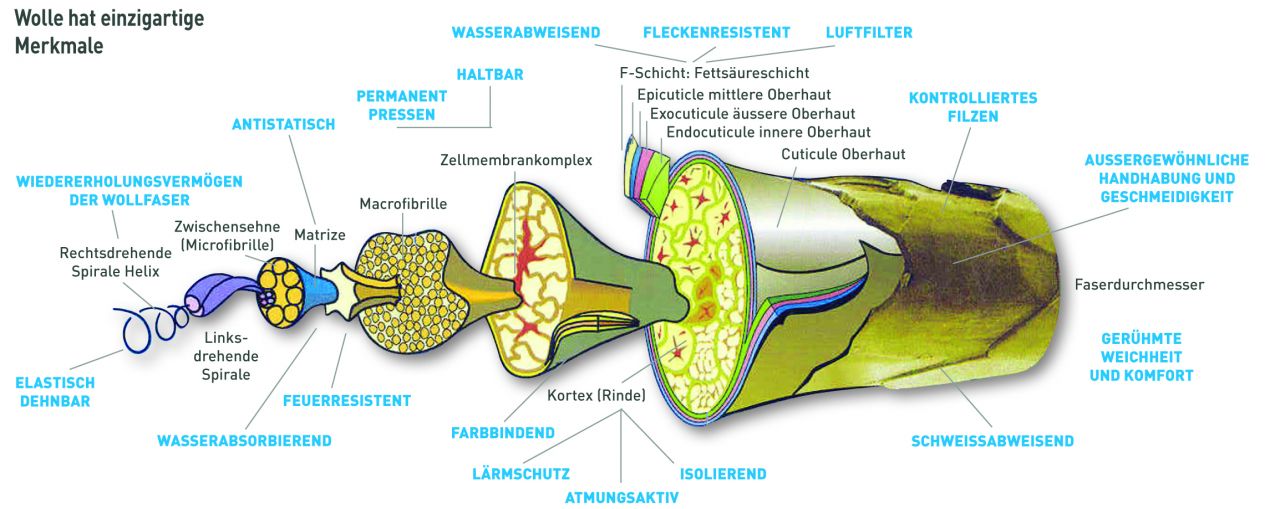
We use mulesing-free virgin wool from Australia and South America with a low vegetable matter content of less than 0.5% and a clean top (combed wool) with a fineness between 18.5-21.5 microns.
For certain items, we also process German wool from the Rhön sheep or Swiss mountain sheep. Although these wools are much coarser, they have their specific appeal.
For the layman, suffice it to say: not all wool is created equal!
Simply trust your instincts, the brand, or ask.
If manufacturers process purchased yarns from existing assortments, they do not know exactly which wools are contained, or they rely on the information of the yarn or preliminary supplier. If they buy wool themselves and spin it themselves, they have the advantage of knowing what raw material was processed.