


Silk
Fashion and Homeware
Silk is primarily used to produce flowing, light, thin fabrics. These are used for scarves, blouses, shirts, shawls, ties, but also as filling material in the duvet industry, known as wild silk fillings for light silk summer duvets.
The wild silk summer duvet as a quilted bed with silk filling
These are widely offered and promoted in the bedding range as light quilted or duvets with silk fillings. A large selection can be found in specialist bed shops, bed retailers, large online portals, and even aggressively priced individual offers, often with blends, at discounters.
Wild silk (Tussah silk) has less inherent odor than mulberry silk and is therefore preferred for duvets and sometimes offered at very aggressive prices. How is this possible, as we know silk as a relatively expensive luxury item?
Worth Knowing
Material
For silk fillings, the cheaper Tussah (wild silk) comber noils are generally used. These accumulate in the combing mill when the short fibre content, neps, and impurities are combed out. From these Tussah comber noils, a more voluminous non-woven fibre web is then created in a further processing step using carding, which serves as an insert. Unfortunately, the advantage of silk's washability (even if the noils are somewhat coarser) doesn't really apply here, because the fibre web collapses when it comes into contact with water and during washing. As a superfine fibre, silk has only low bulkiness and naturally feels relatively flat and hard. Often, attempts are made to achieve greater volume by blending with cotton. However, the bulkiness of cotton is also low. It may be that these thin duvets are suitable for summer and consumers are satisfied and happy. From a climatic point of view, this is acceptable. Especially since the type and manner of the cover fabric of the duvet, usually made of cotton, is also a quality criterion.
From my personal point of view, silk with its characteristic features as one normally sees, knows, and perceives them, i.e., its high strength and fineness with the possibility of spinning very fine yarns for, for example, light cloths with radiant colours, performs much better.
Silk has a different colour affinity than wool, which means that duvets or fabrics with patterns can be created that only become visible after the dyeing process (differential dyeing).
Silk Sheen
Due to its triangular cross-section, silk has good light-reflecting properties, which is why colours on silk show to such advantage.
Keratin Fibre (of animal origin, production)
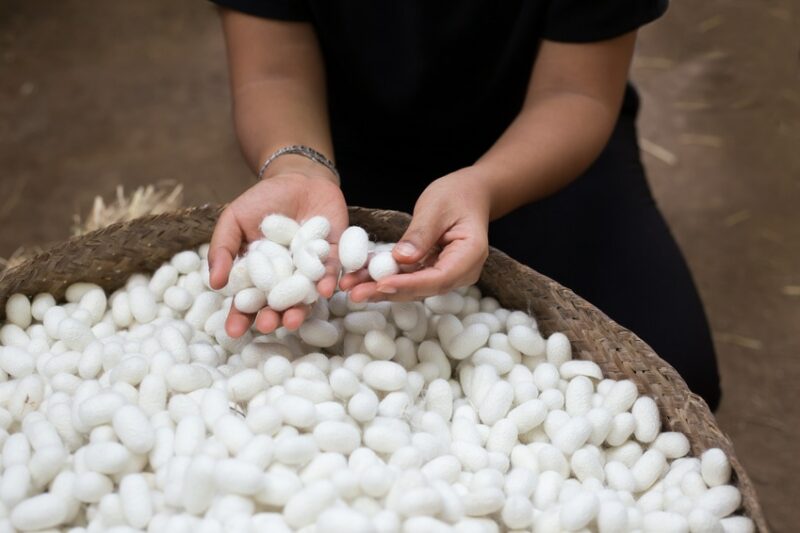
Silk is a keratin fibre (animal fibre) produced from the cocoon of the silkworm.
Reeling and Production
A special feature is that silk is endless and is produced by reeling the cocoon threads of the silkworm or butterfly larva, by throwing the cocoons of the larvae into a large container with hot water. The threads of the cocoon then detach from the cocoon. These collected threads are then picked up, e.g., with a wooden stick, in the hot water, and the threads are pulled over a roller and wound onto a reel. Silk is therefore also referred to as a continuous filament.
Degumming and Aftertreatment
Only through the degumming process or removal of sericin (also silk gum, bast, natural adhesive) and through the subsequent weighting with metal salts does silk gain volume, fullness, and lustre.
The fibroin constitutes the actual thread.
Color and Surface Structure, Washable
Mulberry silk is white, has no scale structure, is smooth, so to speak, and can therefore be washed without problems. That's why silk has no felting properties (which requires a scale structure). In principle, similar to a synthetic fiber or plant fiber.
Authenticity Test
To test silk from imitation silk, it is sufficient to rub 2 layers of fabric together between your thumb and forefinger with pressure. You will then hear a slight crunching sound, which is characteristic of silk. If you light a silk thread, the fire extinguishes itself and you perceive a smell of burnt horn. Similar to burning hair. The cross-section of silk is triangular (visible under a microscope).
High Strength
Silk possesses high strength and fineness. That's why silk was used between 1850-1947 for dense and airtight fabrics to cover airships, balloons, and parachutes.
Substitute for Silk
Only from 1947 onwards was polyester produced by Du Pont and replaced silk for functional textiles, because polyester was correspondingly cheaper and could be produced industrially.
Principle of Silk Production 5000 years ago
Mulberry Silk: The cocoon thread of the mulberry silkworm was already known 5000 years ago. To produce 250 grams of silk, approximately 1 kg of cocoons are needed, which corresponds to an amount of about 3000 cocoons. Even today, kimonos are made from silk.
World Production: 30,000 tons
Producing Countries: Japan approx. 50%, China, Indochina, Persia, Greece, Italy, and France
Fineness 8-15 microns (double thread)
Cross-section: triangular.
Prices as of March 2018, Source: Stucken:
Mulberry silk, cut approx. 35 Euro/kg,
Tussah silk (wild silk) bleached, cut approx. 28.50 Euro/kg
Tussah noil (wild silk) approx. 14 Euro/kg
