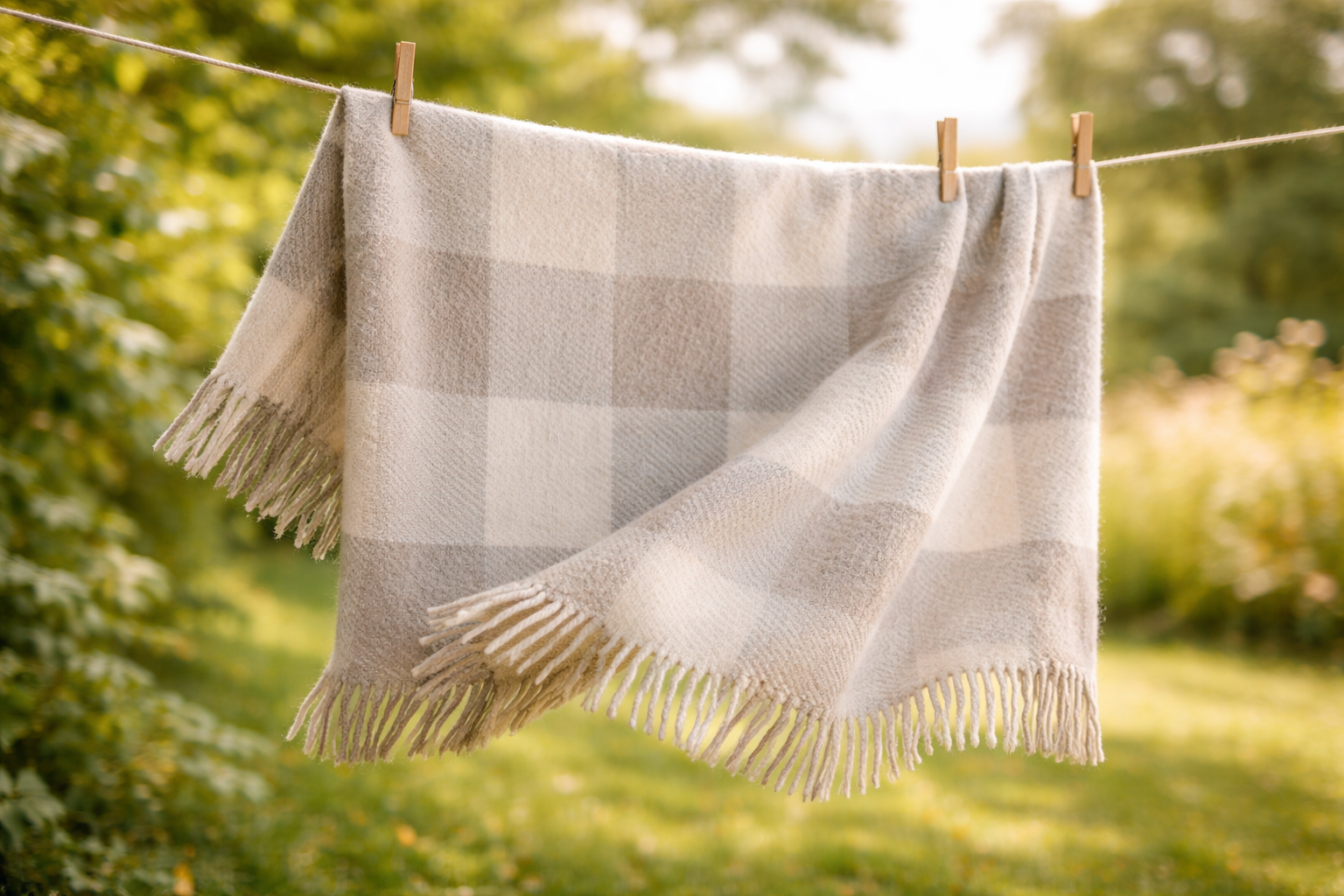
Washing cashmere blankets - Gentle care for noble fibers
Cashmere is one of the most luxurious and delicate natural fibers. Washing a cashmere blanket requires special care to preserve its unique softness. As a manufacturer, we will show you how to properly care for your valuable blanket.

Washing and Drying a Cashmere Blanket – Instructions for the Noble Fiber
Washing a cashmere blanket is a task that makes many owners feel unsure. Rightly so, because cashmere reacts even more sensitively to incorrect treatment than ordinary virgin wool. The fine fibers, with a diameter of only 14 to 19 microns, demand special care.
At Ritter Decken, we have been manufacturing high-quality cashmere blankets in Germany for generations. We know the properties of this noble fiber precisely and understand how to care for your valuable blanket without compromising its unique softness. In this guide, we share our knowledge with you.
Why Cashmere Needs Special Care
Cashmere fibers come from the fine undercoat of the cashmere goat, which lives in the high plateaus of Central Asia. To protect itself from extreme cold, the goat develops a particularly soft, insulating undercoat. This precious material is combed out once a year during the shedding season.
The extraordinary fineness makes cashmere so soft and comfortable on the skin. At the same time, however, it means a high sensitivity to friction, heat, and mechanical stress. The scale structure of the cashmere fiber tends to felt and shrink with improper treatment.
A natural fat content protects cashmere fibers from dirt. In normal use, you will find that your blanket hardly gets dirty. Body sweat is neutralized by the natural structure of the fiber. Even after years, a cashmere blanket does not smell unpleasant if you air it regularly.
Can You Wash a Cashmere Blanket Yourself?
The good news is: Yes, you can wash your cashmere blanket yourself. However, you should ask yourself if it is really necessary. High-quality cashmere blankets are extensively washed with natural soap during manufacturing and are hygienically flawless.
At Ritter Decken, we recommend not washing your natural hair blanket before the first use. The blankets contain no softeners or chemical additives that would need to be washed out. They are purely mechanically finished and ready for immediate use.
Instead of washing, occasionally air your cashmere blanket outdoors. Choose a sheltered area with the highest possible humidity. The pile will recover, and the fine fibers will regenerate optimally. This method preserves the quality of your blanket for many years without exposing it to the risks of washing.
Washing a Cashmere Blanket – Hand Wash or Washing Machine?
If you want to wash your cashmere blanket, you essentially have two methods available. Hand washing is the gentler option, while machine washing is also possible if done correctly.
Hand Washing as the Gentlest Method
Fill your bathtub or a large container with lukewarm water. The temperature should not exceed 30 degrees Celsius. Dissolve a mild wool detergent or conditioner completely in the water before immersing the blanket.
Carefully immerse the cashmere blanket and gently move it in the water. Lightly press the water through the fibers without rubbing, wringing, or kneading. Let the blanket soak in the water for about 10 minutes. Then rinse several times with clear water of the same temperature until no detergent residue remains.
Washing a Cashmere Blanket in the Washing Machine
If you want to use the washing machine, be sure to select the wool wash program or hand wash program. Set the coldest available temperature. Always wash the cashmere blanket separately, as additional load causes friction and promotes felting.
Reduce the spin speed to a maximum of 400 revolutions per minute and stop the spin cycle after 2 to 3 minutes. The blanket does not need to be completely spin-dried. A certain residual moisture is even advantageous for the subsequent gentle drying.
The Right Detergent for Cashmere
Use a special cashmere detergent or a mild wool detergent. A proven alternative is commercial hair conditioner, which nourishes the fine fibers and keeps them supple. Add the detergent to the main wash cycle.
Heavy-duty detergents and bleach are taboo for cashmere. They contain enzymes and aggressive substances that damage the delicate fibers. Fabric softener is unnecessary, as high-quality natural hair blankets are naturally soft and do not require chemical additives.

The Right Temperature for Washing a Cashmere Blanket
Temperature is one of the most critical factors when washing a cashmere blanket. Water that is too warm activates the scale structure of the fibers and inevitably leads to felting.
|
Temperature |
Effect on Cashmere |
|---|---|
|
Cold (below 20°C) |
Optimal, no felting risk |
|
20 to 30°C |
Acceptable, low risk |
|
30 to 40°C |
Increased risk, not recommended |
|
Above 40°C |
Unsuitable, felting and shrinking |
Be careful to avoid temperature shocks. The rinse water should have the same temperature as the wash water. A sudden change from warm to cold can also damage the fibers.
Can a Cashmere Blanket Go in the Dryer?
The answer is clear: Never put your cashmere blanket in the tumble dryer. Cashmere is even more delicate than ordinary virgin wool and does not tolerate the combination of heat and mechanical movement at all.
Even gentle programs with low temperatures are not suitable for cashmere. The drum movement would felt the fine fibers and destroy the characteristic softness. The beautiful pile, which we produce with great effort during manufacturing, would be irretrievably lost.
The only correct method for cashmere is air drying. It requires more time and patience but preserves the quality of your valuable blanket.
Properly Drying a Cashmere Blanket – Step by Step
Drying a cashmere blanket differs from treating more robust wool blankets. The fine fibers require special care.
Gently Removing Moisture
Lay the wet cashmere blanket on a large, absorbent cotton towel. Gently roll both together without wringing or pressing. The towel will absorb the excess moisture. Repeat this process with a dry towel if necessary.
Drying Flat for Optimal Results
Unlike more robust virgin wool blankets, you should dry a cashmere blanket flat. Spread several dry towels on a flat surface and lay the blanket on top. The weight of a wet blanket would distort the fine fibers if hung.
Choose an airy, shady spot without direct sunlight. UV rays can bleach cashmere. Also, avoid proximity to radiators or other heat sources. Turn the blanket regularly so that it dries evenly. Depending on the room climate, complete drying can take 24 to 48 hours.
Shaping After Drying
Once the blanket is completely dry, gently pull it into shape. Shake it lightly to loosen the pile. If necessary, you can use a cashmere comb or a very soft brush to smooth the surface. Always brush in one direction.

Removing and Preventing Pilling on Cashmere Blankets
Small knots on the surface, known as pilling, are a natural phenomenon with cashmere. They are caused by friction and are not a sign of poor quality. On the contrary, pilling indicates genuine, fine natural fibers.
Carefully remove the knots with a special cashmere comb or a lint shaver. Work gently and in one direction to avoid damaging the fibers. After a few treatments, pilling will decrease as the loose fibers have been removed.
Properly Storing and Caring for a Cashmere Blanket
The best care for your cashmere blanket is regular airing instead of frequent washing. Occasionally hang the blanket outdoors in a sheltered area. High humidity supports the regeneration of the fine fibers.
If you are not using your cashmere blanket for an extended period, store it in an airtight bag or plastic bag. This reliably protects against moth damage. Moths love cashmere even more than ordinary wool. As a natural alternative, you can add cedar wood pieces, whose scent repels moths. Do not place mothballs directly on the blanket, as they can leave odors.
Dry Cleaning for Cashmere Blankets
We generally advise against dry cleaning. The process removes the natural fat content from the fiber, which keeps cashmere supple and protects against dirt. After dry cleaning, the blanket often feels stiff and can have an unpleasant smell.
Only for stubborn stains that cannot be removed with household remedies should professional cleaning be considered. In such cases, choose a cleaner experienced with cashmere. Emphasize the delicate material.
High-Quality Cashmere Blankets from Ritter Decken
In our assortment, you will find various cashmere qualities for different needs. From Kaschmount to Kirman Schah to Kaschimoon, we offer natural hair blankets of specialist retail quality. All our cashmere blankets are manufactured in Germany and tested for harmful substances by the Bremen Environmental Institute.
The owner personally purchases the raw materials from established importers and oversees the entire manufacturing process. This care is reflected in the quality that will accompany you for many years.
We would be happy to send you a free sample so you can experience the quality of our cashmere blankets for yourself. For questions about care or selection, you can reach us at 07033-32174. Also, visit our outlet in Weil der Stadt, where you can feel and compare all qualities.