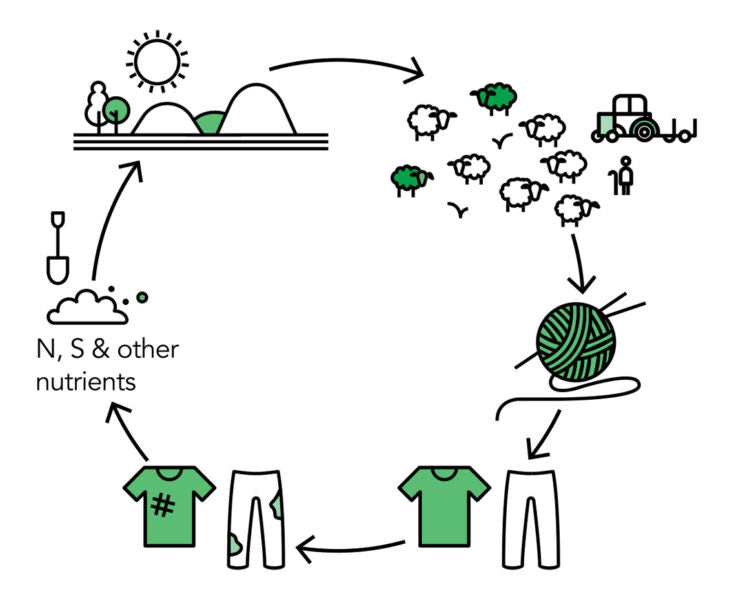
How Wool Reduces Climate Impact
The use phase is one of the most significant phases in a product’s lifecycle. This is the time when a consumer owns, wears/uses, washes, and cares for a garment.
Research has shown that the way we use a garment differs depending on its fiber content. To understand the true environmental impact of a garment, the use phase must be considered.
There are several reasons why the use, wear, and care of wool differs significantly from other fibers and can make a real contribution to reducing environmental impact.
Wool is washed less frequently
In a study on the consumer use phase of clothing worldwide, researchers analyzed how often clothes are worn before washing. Wool was worn more often before washing than other fibers.
This saves energy and water, as well as time.
Why can wool clothing be washed less often?
The natural properties of wool fiber include odor resistance and resilience (i.e., it retains its shape longer and regains its shape after wear). Wool clothing can be refreshed simply by airing it out. You can hang garments to air out or in the bathroom while showering, where the steam helps release wrinkles.
Typical Use Phase Characteristics for Cotton and Wool Items
| Product Category |
Weight Unit (kg) |
Fiber | Wears per Wash | Garment Lifespan (Years) | Wears per Life (Number) | Washes per Year per Unit |
| Assumed | Example | Laitala et al. Table 6 | Laitala et al. Table 8 | Data from Cotton Inc. | By Derivation | |
| Socks | 0.05 | Cotton | 1.5 | 3.3 | 52.3 | 10.6 |
| 0.05 | Wool | 2.5 | 5.5 | 52.3 | 3.8 | |
| T-Shirt (Base Layer) | 0.2 | Cotton | 1.5 | 4.6 | 36.4 | 5.3 |
| 0.2 | Wool | 3 | 4.6 | 40.5 | 2.9 | |
| Sweater (Mid/Outer) | 0.3 | Cotton | 5 | 5.6 | 81.4 | 2.9 |
| 0.3 | Wool | 10 | 6.0 | 92.4 | 1.5 |

Wool is washed at lower temperatures
Washing at lower temperatures means less energy consumption per wash cycle. A German study on consumer behavior found that consumers wash wool at an average of 30.3°C, compared to cotton at an average of 41.1°C.3
Wool is line-dried
Tumble drying wool is generally not recommended as the mechanical friction is not good for the fibers. Therefore, most wool garments are line-dried. This is great news for the environment, as dryers consume more electricity, while outdoor drying uses no electricity – which is also good news for your electricity bill.
Wool clothing can have a longer lifespan
The longer a product is used, the less impact it has on the environment, as all manufacturing costs are spread over time, and no other resources are used to replace it.
Wool garments often last longer than garments made from other fibers due to the quality of the garment and possibly due to less frequent washing.
Provided that wool clothing is well-used, environmental impacts can be reduced, and fewer new garments need to be purchased.
Wool does not contribute to microplastic pollution
This could potentially be the most important reason of all. All textiles release fibers, but wool fibers biodegrade in soil and water (saltwater as well as fresh water) and do not contribute to microplastic contamination.
Read more about how wool is biodegradable with us.

1 Laitala, K., Klepp, I., & Henry, B. (2018), “Used Matters? Comparing the Environmental
Impacts of Clothing Based on Fibre Type”, Sustainability, 10, 2524.
2 Ibid. Note that no data is currently available for synthetic and artificial cellulosic fibers.
3 Berkholz, P.; Brückner, A.; Kruschwitz, A.; Stamminger, R. Consumer Behavior and Behavior-Dependent Saving Potentials During Washing Machine Operation Slightly Amended Version of a Study
Conducted on Behalf of the Federal Ministry of Economics and Technology (BMWi—Project Number: 86/05 az: I a 2—00 09 80); Shaker-Verlag: Aachen, Germany, 2007.
Author: International Wool, Textile Organisation
Article image: pixabay.com