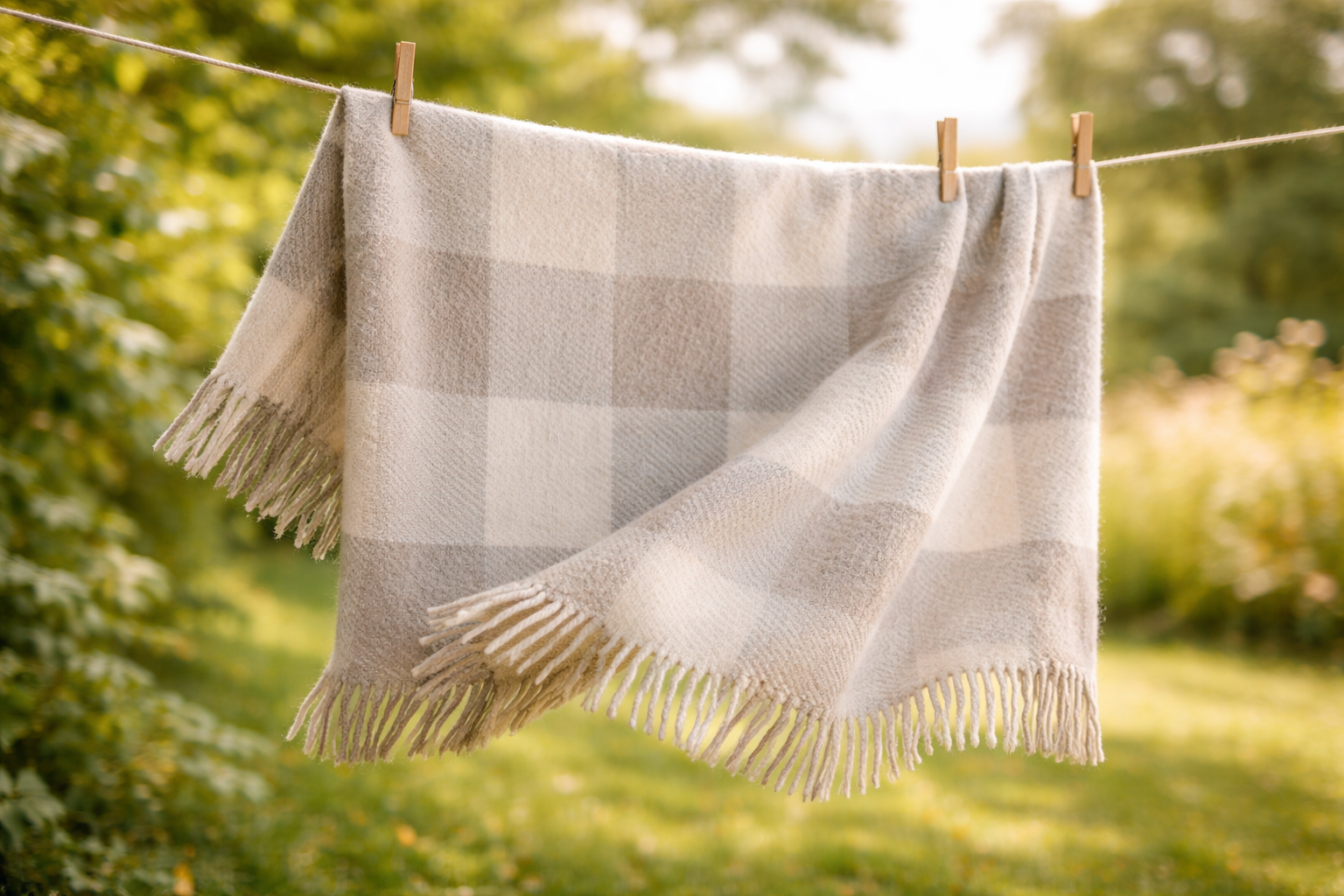
Wool is biodegradable
Wool consists of keratin, the same protein as human hair. Wool grows naturally on sheep, just like our hair. Through biodegradation, microorganisms in the soil or water break down and consume substances. These microorganisms completely degrade during their life cycle. This is how biological life cycles develop from one to the next.
Easy biodegradability is crucial for sustainability
Tests show that under ideal conditions, wool products are almost completely degraded after only six months in the soil.1
Due to the unique structure of wool and its water-repellent outer membrane, wool fibers are durable and long-lasting when a wool garment is worn and cared for. Under moist, warm conditions, wool biodegrades.
Biodegradation in the sea
Wool is also biodegradable in water.1 Early results of current research in New Zealand show that various types of wool were about 20% biodegraded after only 90 days in saltwater.2
Further research is underway to determine how quickly wool biodegrades at different sea levels and temperatures.
Biodegradation of textile fibers

Wool is easy to compost
Research has shown that wool acts as an effective soil improver and fertilizer, slowly releasing sulfur, nitrogen, phosphorus, and potassium during biodegradation.3
In addition, wool fibers have been shown to biodegrade significantly faster than synthetic fibers in soil, composting, and marine environments. Previous research examining the impact of modern wool fiber processing shows that typical dyes and standard machine wash treatments do not significantly reduce the relative biodegradation rates between wool and synthetic fibers.
Furthermore, we now know that synthetic textiles are not only extremely slow to biodegrade but can also break down into fragments, known as microplastics. A single fleece garment can produce more than 1,900 fibers per wash.4
Wool in the marine environment1
- Bacteria, not fungi, have been observed to play a significant role in marine degradation.
- Bacteria isolated in New Zealand were in the Alteromonas and Oceanospirillum groups.
- After 7 to 8 months, degradation is already well advanced.
Biodegradation of wool

1 Brown, R. The microbial degradation of wool in the marine environment. University of Canterbury, 1994 – https://ir.canterbury.ac.nz/handle/10092/16802
2 Ranford, Steve (April 2019). Biodegradation of Wool: Presented at the 88th IWTO Congress in Venice.
3 Valtcho D. Jeliazkov (2005), Assessment of Wool Waste and Hair Waste as Soil Amendment and Nutrient Source, Journal of Environmental Quality, 34(6), 2310-17, DOI: 10.2134/jeq2004.0332.
4 Browne, M.A., Crump, P., Niven, S.J., Teuten, E., Tonkin, A., Galloway, T., Thompson, R., 2011. Accumulation of microplastic on shores worldwide: sources and sinks. Environ. Sci. Technol. 45,
9175-9179.
Author: Dr. Paul Swan, www.iwto.org